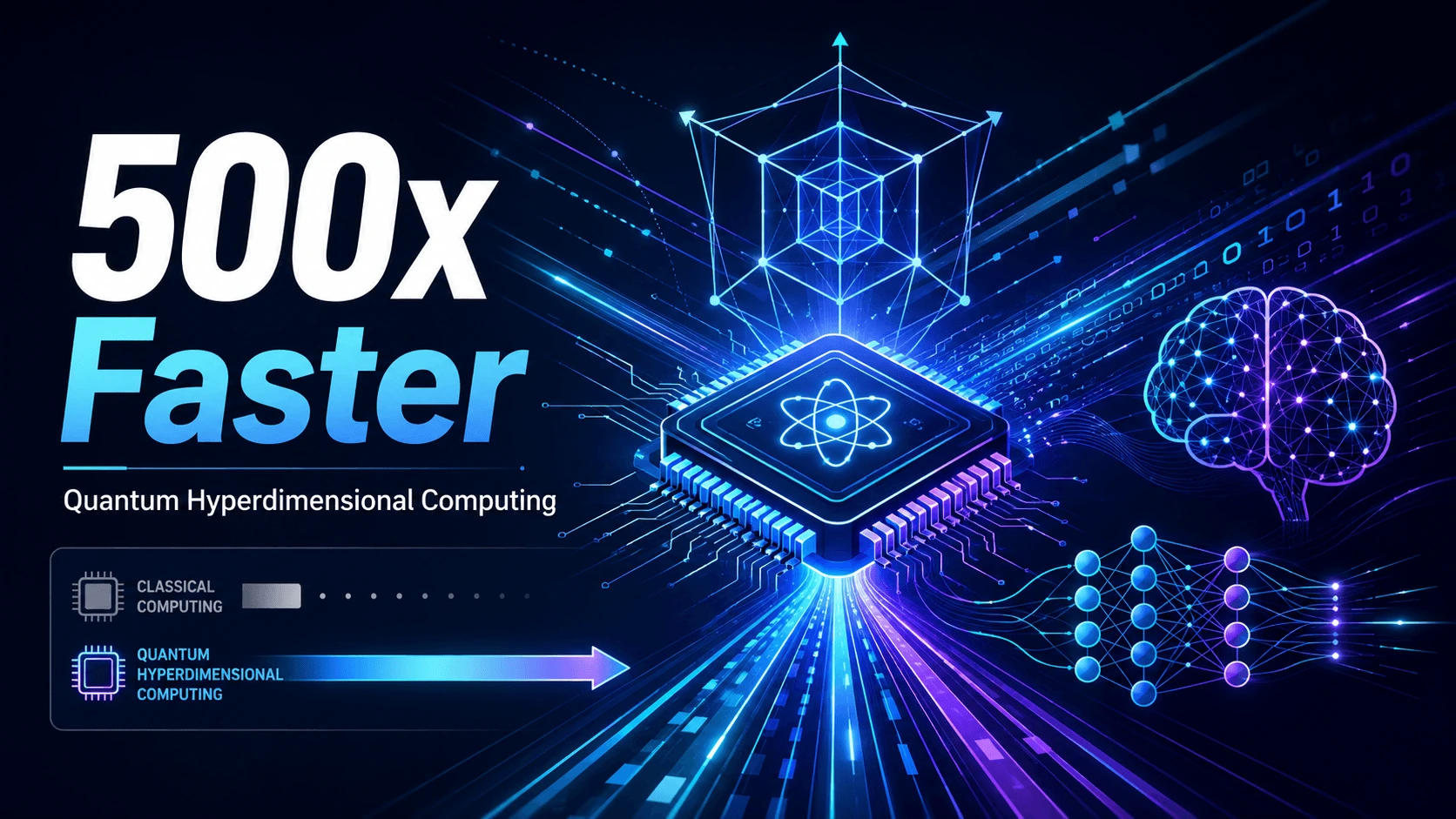
Cleveland Clinic researchers say a new form of quantum computing inspired by the human brain performed nearly 500 times faster than some existing quantum machine-learning methods in early tests, a development that could point to faster ways of analyzing complex medical and scientific data.
The approach, called quantum hyperdimensional computing, or QHDC, was introduced in a peer-reviewed study published in npj Unconventional Computing. The work marks the first implementation of the framework, which combines quantum computing with hyperdimensional computing, a model based on how information is believed to be distributed across networks in the brain.
Traditional computing usually stores and processes information in precise, structured ways. Hyperdimensional computing takes a different approach. It represents information across large mathematical objects known as hypervectors, making systems more tolerant of noise and errors. That idea mirrors the way the brain does not store a concept, such as “cat,” in a single neuron, but across many connected neurons.
The Cleveland Clinic team adapted that model for quantum hardware, where qubits can use quantum properties such as superposition to represent many possible states at once. The researchers argue that this makes QHDC a more natural fit for quantum computers than many current algorithms, which often begin as classical models and are then modified for quantum systems.
“Most quantum computing software is still built by borrowing ideas from classical computing,” said Fabio Cumbo, Ph.D., the study’s lead author and a research associate at Cleveland Clinic.
The team tested the framework in two ways. One experiment examined symbolic reasoning, while the other measured how well the system handled a supervised classification task, a common machine-learning problem involving image data. The researchers compared performance using classical computing, an ideal quantum simulator and a real quantum computer.
In one benchmark, QHDC completed a cross-validation task in about 28 seconds on average. Two other quantum machine-learning models, known as variational quantum classifiers and quantum support vector classifiers, took nearly 3.8 hours per fold in the same ideal simulation setting. That difference produced the roughly 500-fold speedup reported by the researchers.
The results also showed a tradeoff. QHDC delivered competitive classification performance, but one comparison model achieved slightly higher accuracy. That means the finding is not a simple case of one system outperforming every alternative in every category. Instead, the study suggests QHDC may offer a more efficient architecture for certain types of quantum machine-learning tasks.
Researchers say the potential applications are especially important for biomedical research, where scientists often work with massive, complex data sets. In the future, quantum-native systems could help compare genomic profiles, classify medical images or search large biological databases more efficiently.
Still, the technology remains early. The study shows that QHDC can be physically implemented and tested on quantum hardware, but broader real-world advantages will depend on larger models, more advanced quantum processors and further validation outside controlled experiments.
For now, the work offers a promising direction for quantum computing: instead of forcing older computing ideas onto new machines, researchers are designing methods that better match how quantum hardware actually works. If that approach scales, QHDC could become part of a new generation of faster, more efficient tools for science and medicine.