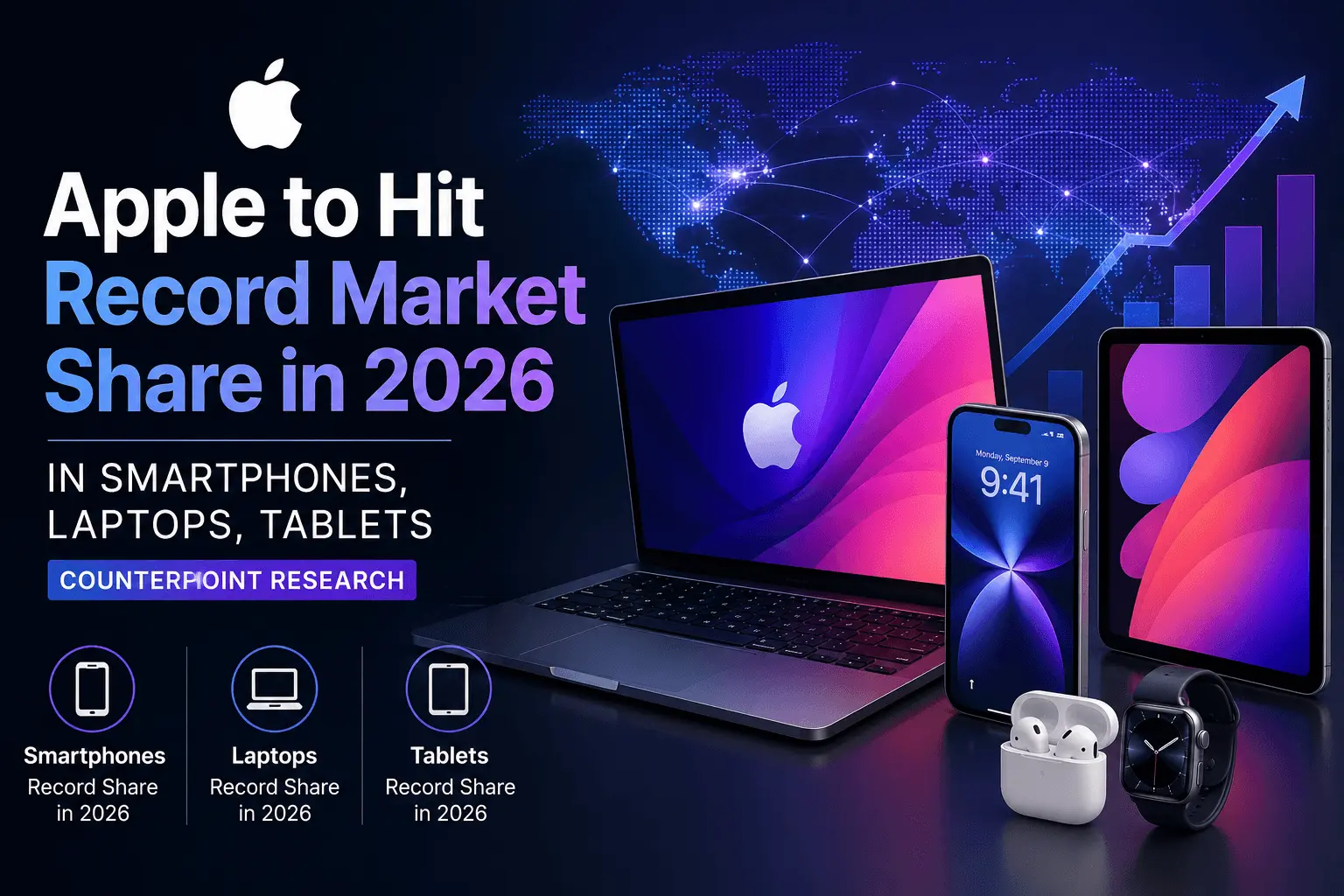
The technology industry is entering another transformative year, and Apple record market share 2026 is quickly becoming one of the biggest talking points. According to the latest Counterpoint Research Apple report, Apple is on track to capture record market share across smartphones, laptops, and tablets in 2026. While the broader consumer electronics industry continues to face changing demand patterns, Apple appears well-positioned to strengthen its leadership through premium products, a tightly integrated ecosystem, and continued customer loyalty.
The forecast highlights more than just strong sales. It reflects growing confidence in Apple device market growth, supported by expanding services, AI-powered features, and consistent hardware upgrades. From the iPhone market share 2026 outlook to projections for MacBook and iPad shipments, Apple’s strategy continues to differentiate it from competitors.
For consumers, investors, and industry watchers, these projections offer valuable insight into where the technology market is heading. Here’s a closer look at why Apple is expected to outperform much of the consumer electronics industry in 2026.
Why Counterpoint Expects Apple to Reach Record Market Share
According to the latest Counterpoint smartphone forecast, Apple is projected to post its highest-ever combined share of the smartphone, laptop, and tablet markets in 2026. Rather than relying solely on unit shipments, the company’s success is expected to come from its ability to attract premium buyers and encourage existing customers to remain within its ecosystem.
Several trends support this outlook:
- Growing demand for premium consumer electronics.
- Continued expansion of the Apple hardware ecosystem.
- Higher upgrade rates among existing users.
- AI-powered software experiences integrated across devices.
- Strong brand loyalty in mature and emerging markets.
Unlike many hardware manufacturers competing primarily on price, Apple has consistently focused on delivering a premium experience. That approach has translated into higher customer retention and stronger profitability, even during periods of slower global device demand.
Apple’s Smartphone Business Continues to Lead Premium Sales
The Apple smartphone market share 2026 forecast remains one of the strongest drivers behind the company’s expected record performance.
Although Android manufacturers collectively ship more devices worldwide, Apple continues to dominate the premium smartphone segment. High-end iPhone models consistently account for a significant share of premium smartphone sales globally, giving Apple an advantage in both revenue and profitability.
Several factors are expected to fuel iPhone shipments 2026:
Strong Upgrade Demand
Millions of customers are expected to replace devices purchased during previous upgrade cycles. Improved battery life, faster processors, enhanced cameras, and new AI capabilities could encourage another wave of upgrades.
This renewed iPhone upgrade demand is likely to contribute significantly to Apple’s overall sales growth in 2026.
Ecosystem Lock-In
Consumers who own an iPhone often expand into other Apple products, including:
- MacBook
- iPad
- Apple Watch
- AirPods
- Apple TV
Features such as AirDrop, Handoff, Universal Clipboard, iCloud synchronization, and cross-device messaging make switching platforms less attractive. This ongoing Apple ecosystem expansion remains one of the company’s greatest competitive strengths.
Premium Pricing Strategy
Rather than chasing market share through lower prices, Apple continues to focus on premium devices. Even if global smartphone shipments fluctuate, the company benefits from higher average selling prices and greater customer loyalty.
This strategy reinforces Apple’s position within the Apple consumer electronics market, where premium products continue attracting consumers willing to invest in long-lasting devices.
MacBook Market Share Could Reach New Highs
The Apple laptop market share outlook is equally optimistic.
Following the transition to Apple Silicon, MacBook performance has improved dramatically while maintaining exceptional battery life. These advantages continue attracting professionals, students, creators, and business users.
Industry analysts expect Mac shipments 2026 to increase as businesses replace aging computers and consumers upgrade to newer Apple Silicon models.
Several trends support MacBook market share 2026 growth:
Apple Silicon Continues to Deliver
Apple’s custom processors have reshaped expectations for laptop performance.
Benefits include:
- Longer battery life
- Better thermal efficiency
- Faster creative workflows
- Enhanced AI processing
- Improved security
These improvements strengthen Apple’s position within the global PC market share landscape.
Hybrid Work Still Matters
Remote and hybrid work continue influencing purchasing decisions.
Professionals increasingly prioritize portability, battery life, and seamless connectivity across devices. MacBooks meet these needs while integrating naturally with iPhones and iPads.
As a result, MacBook demand 2026 is expected to remain healthy despite ongoing competition from Windows laptop manufacturers.
iPad Maintains Leadership in the Tablet Market
Apple has long dominated premium tablets, and the Apple tablet market share forecast suggests this leadership will continue through 2026.
Although Android tablets remain available across many price points, the iPad continues to lead among professionals, educators, students, and creative users.
The projected iPad market share 2026 reflects continued demand across several categories:
- Education
- Digital illustration
- Video editing
- Business productivity
- Content consumption
The expected rise in iPad shipments 2026 is also supported by increasing demand for accessories such as the Apple Pencil and Magic Keyboard, transforming the tablet into a capable productivity device.
Apple’s consistent software updates further extend device lifespan, strengthening customer satisfaction while encouraging long-term ecosystem adoption.
The Apple Ecosystem Remains the Company’s Biggest Competitive Advantage
One of the strongest drivers behind Apple market performance is not any single product—it’s the way every product works together.
A customer who purchases an iPhone often finds added value in owning a MacBook, iPad, Apple Watch, and AirPods. This interconnected experience creates convenience that competitors still struggle to match.
Examples include:
- Instantly copying content between devices.
- Answering phone calls from a MacBook.
- Starting work on an iPad and finishing it on a Mac.
- Automatic photo synchronization through iCloud.
- Seamless file sharing with AirDrop.
This integrated approach supports ongoing Apple installed base growth, reinforces Apple premium ecosystem adoption, and strengthens long-term customer retention.
As more consumers invest in multiple Apple products, the company benefits from recurring hardware upgrades, service subscriptions, and higher lifetime customer value.
Apple’s AI Strategy Is Becoming a Key Growth Driver
Artificial intelligence is expected to play a much larger role in Apple’s product strategy throughout 2026. While many competitors have focused on cloud-based AI services, Apple is emphasizing on-device intelligence that prioritizes privacy, speed, and efficiency.
The introduction of AI-powered features across iPhone, Mac, and iPad is expected to accelerate the Apple device upgrade cycle, particularly among users holding devices that are several years old.
AI-enhanced writing tools, image editing, voice assistance, productivity features, and smarter search experiences are likely to become important reasons for consumers to upgrade. As a result, AI-powered devices Apple plans could become another major contributor to Apple sales growth 2026.
Unlike standalone AI products, Apple integrates these capabilities directly into its hardware ecosystem, making them immediately useful across multiple devices.
Premium Device Demand Continues to Favor Apple
Despite economic uncertainty in several regions, the market for premium consumer electronics remains resilient. Consumers are increasingly choosing devices that offer longer software support, better resale value, stronger security, and seamless integration with other products.
This trend directly benefits Apple.
Rather than competing aggressively in entry-level segments, the company has consistently focused on premium products where profit margins are higher. That strategy has helped Apple maintain healthy financial performance even when overall shipment growth slowed across the industry.
Growing premium device demand is expected to support continued Apple product demand in 2026, particularly in developed markets such as the United States, Canada, Japan, and Western Europe.
Global Market Forecasts Support Apple’s Growth
The broader global smartphone market 2026 is expected to return to moderate growth after several years of fluctuating demand. Replacement cycles are gradually improving, and AI-enabled smartphones are likely to encourage consumers to purchase newer devices.
Within this environment, Apple is forecast to strengthen its position through continued premium sales rather than pursuing volume alone.
Similarly, the laptop market forecast 2026 points to increased enterprise upgrades, education demand, and ongoing replacement of older PCs. Apple’s Mac lineup is well positioned to benefit from these trends, particularly as businesses continue adopting Apple Silicon-powered devices.
The tablet market forecast 2026 also remains favorable for Apple. Although tablets experienced slower demand following the pandemic boom, education, remote work, healthcare, and creative industries continue to generate consistent interest in high-performance devices like the iPad.
These market conditions reinforce expectations for sustained Apple worldwide sales growth across all major hardware categories.
Apple’s Brand Loyalty Continues to Set It Apart
One of Apple’s greatest competitive strengths is its exceptionally loyal customer base.
Independent surveys consistently show that a large percentage of iPhone owners choose another iPhone when upgrading. Similar patterns exist among Mac and iPad users, demonstrating the strength of Apple brand loyalty.
Several factors contribute to this loyalty:
- Reliable software updates for many years
- Strong privacy and security protections
- High product quality
- Excellent customer support
- Seamless device integration
- Strong resale values
These advantages help explain why Apple continues expanding its installed base even in highly competitive markets.
Apple Innovation Strategy Supports Long-Term Growth
Apple’s success is not driven by annual product launches alone. The company’s broader Apple innovation strategy focuses on creating technologies that improve the user experience across its entire ecosystem.
Recent innovations include:
Custom Silicon
Apple-designed processors have dramatically improved performance while reducing power consumption across iPhone, iPad, and Mac.
Software Integration
Operating systems are increasingly connected, allowing users to move effortlessly between devices.
Services Expansion
Although hardware remains Apple’s primary business, services such as iCloud, Apple Music, Apple TV+, Apple Arcade, and AppleCare continue generating recurring revenue while increasing customer retention.
Combined, these initiatives strengthen Apple revenue drivers and reinforce the company’s position within the global technology industry.
What Apple’s Record Market Share Means for Consumers
Apple’s expected growth is more than a financial milestone—it also reflects changing consumer preferences.
Today’s buyers increasingly value:
- Long-term software support
- Better security
- AI-powered productivity
- Reliable performance
- Device interoperability
- Premium build quality
For consumers already invested in Apple’s ecosystem, future upgrades become even more appealing as new features work seamlessly across multiple devices.
Meanwhile, businesses and educational institutions also benefit from improved management tools, stronger security, and enhanced collaboration across Apple hardware.
Industry Experts See Continued Technology Leadership
Market analysts believe Apple’s ability to combine premium hardware, software, and services gives it a sustainable competitive advantage.
Rather than competing solely on specifications, Apple focuses on delivering a complete user experience. This approach continues strengthening Apple technology leadership and reinforces the company’s reputation for innovation.
As AI becomes more deeply integrated into consumer electronics, Apple’s emphasis on privacy, efficient hardware, and ecosystem connectivity could further widen the gap between the company and many competitors.
These trends support expectations that Apple will maintain strong Apple global market leadership well beyond 2026.
Key Takeaways
The latest Counterpoint projections suggest Apple is entering one of its strongest growth periods in recent years.
Record gains across smartphones, laptops, and tablets are expected to be driven by:
- Continued premium iPhone demand
- Growing MacBook adoption
- Stable iPad leadership
- Expanding AI capabilities
- Strong ecosystem integration
- Exceptional customer loyalty
- Increasing installed base
- Healthy replacement cycles
Together, these factors position Apple to strengthen its presence across the Apple hardware market share landscape while maintaining leadership in premium consumer electronics.
Frequently Asked Questions
1. Why is Apple expected to achieve record market share in 2026?
According to Counterpoint Research, Apple’s combination of premium hardware, AI-powered features, ecosystem integration, and strong customer loyalty is expected to drive record market share across smartphones, laptops, and tablets.
2. Will iPhone market share increase in 2026?
Yes. Analysts expect iPhone market share 2026 to improve due to strong upgrade demand, continued premium smartphone sales, and deeper ecosystem integration.
3. What is driving MacBook growth?
The adoption of Apple Silicon, improved battery life, high performance, and growing enterprise demand are expected to increase MacBook market share 2026 and overall Mac shipments.
4. Why does the Apple ecosystem matter?
Apple’s ecosystem allows devices to work together seamlessly through shared software, cloud services, and cross-device features. This improves user experience and encourages long-term customer retention.
5. How will AI affect Apple’s growth?
AI-powered features integrated into iPhones, Macs, and iPads are expected to encourage faster upgrades, improve productivity, and strengthen Apple’s competitive position in consumer technology.
Conclusion
Apple appears well-positioned to achieve record market share across smartphones, laptops, and tablets in 2026, according to Counterpoint Research. Its combination of premium hardware, custom silicon, AI-driven innovation, and an increasingly interconnected ecosystem continues to differentiate the company in a competitive marketplace.
While the broader technology industry faces evolving consumer expectations, Apple benefits from strong brand loyalty, healthy upgrade cycles, and growing demand for premium devices. If current projections hold true, 2026 could mark another milestone in Apple’s long-term growth story, reinforcing its status as one of the world’s leading technology companies and setting new benchmarks across the global consumer electronics market.