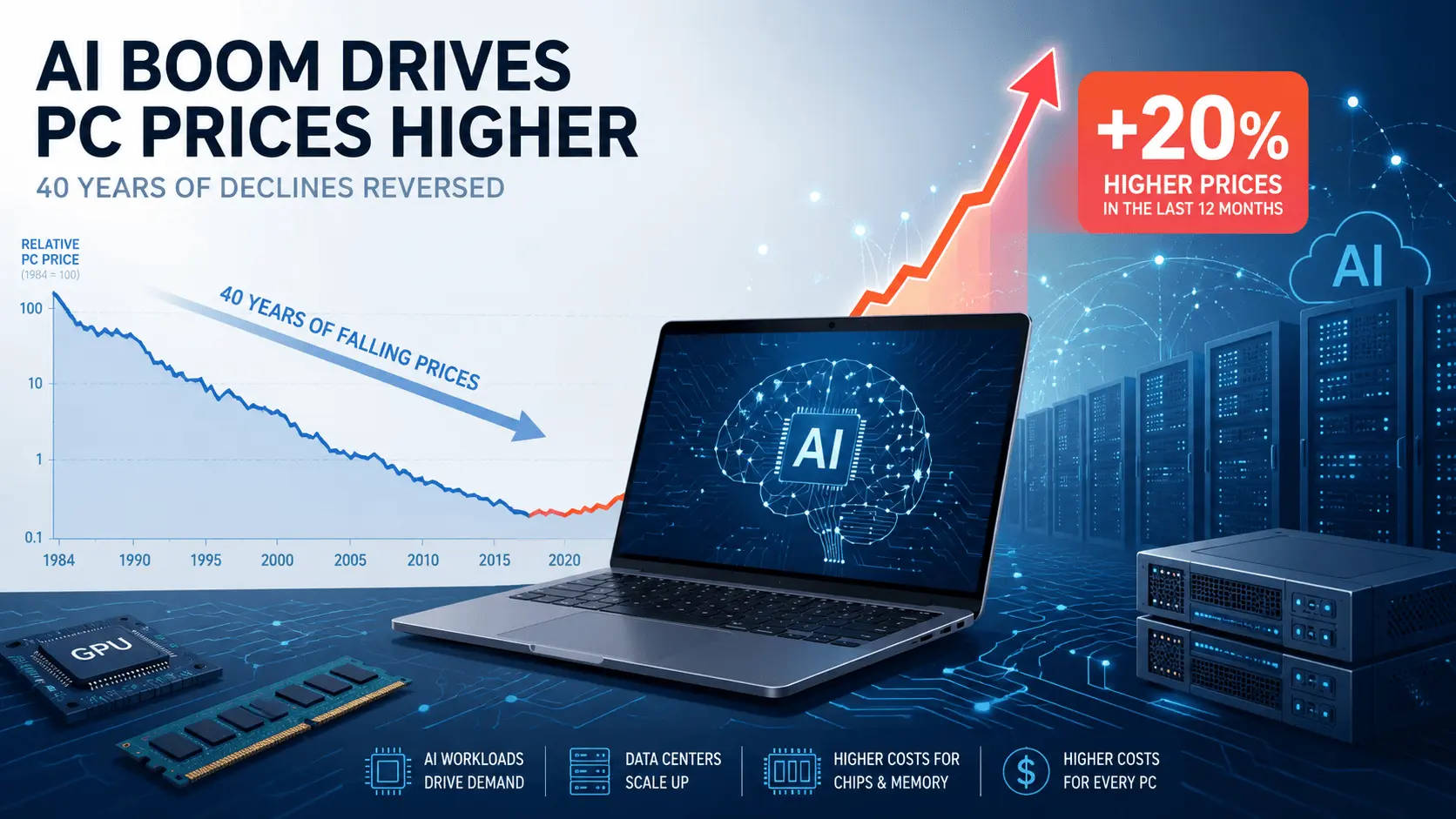
The long era of cheaper personal computers is showing signs of ending, as the artificial intelligence boom drives up demand for the memory chips used in laptops, desktops and other consumer electronics.
For roughly 40 years, Americans buying a new computer could usually expect more power for less money. That pattern was fueled by advances in chipmaking, intense competition and steady improvements in manufacturing. Now, analysts say the rush to build AI data centers is disrupting that trend by pulling critical components away from the consumer PC market.
The pressure is centered on memory chips, including DRAM, NAND storage and high-bandwidth memory used in AI servers. Those parts are essential for both data centers and everyday devices. As technology companies pour money into AI infrastructure, chipmakers are shifting more production toward higher-margin components for enterprise customers.
That leaves fewer parts available for laptops, tablets, smartphones and desktop computers.
Oxford Economics analysts told CBS News that computer prices are rising for the first time since the early 1980s. The firm’s analysis of government data found that costs for computers, software and accessories have recently increased by more than 3% per month.
“We’re talking about chip-intensive products that historically, we’ve seen prices remain flat or decrease,” Bernard Yaros, lead economist at Oxford Economics, told CBS News.
The effect may become more visible to shoppers later this year. Jitesh Ubrani, a research manager at IDC, told Checkbook.org that prices for PCs, tablets and smartphones could rise 10% to 20% before the end of 2026. He said many device makers stocked up early, delaying the impact for consumers, but warned that the pressure could become more noticeable in the second half of the year.
Some price increases are already appearing in the PC industry. Tom’s Hardware, citing IDC’s memory-crisis forecast, reported that average PC acquisition costs could rise 4% to 8% in 2026 depending on how tight the supply crunch becomes. Dell and Lenovo have also signaled price adjustments of up to 15% on some systems, according to the report.
The shortage is not just a short-term supply hiccup. IDC has described it as a possible long-term reallocation of global chipmaking capacity, as manufacturers prioritize the AI market over lower-margin consumer hardware. Analysts expect tight supply to last into 2027 or longer.
For consumers, the change could show up in more than one way. Some laptops may carry higher sticker prices. Others may keep similar prices but come with less memory, smaller storage drives or fewer premium features. That means buyers may need to compare specifications more carefully instead of assuming a newer model is automatically a better deal.
The shift also raises broader questions about who pays for the AI buildout. Tech companies are spending heavily on data centers and advanced chips, but the cost is beginning to spread into everyday electronics. Households that need a new laptop for school, work or home use may face fewer bargains and steeper upgrade costs.
The PC market has weathered supply shocks before, including pandemic-era shortages. But this time, the driver is not a temporary factory shutdown or shipping delay. It is the rapid expansion of AI infrastructure competing directly with consumer technology for the same core components.
For shoppers, the message is practical: buying sooner may avoid some of the coming price increases, but careful comparison will matter more than ever. The age of steadily cheaper computers may not be over forever, but for now, AI is making the next upgrade more expensive.