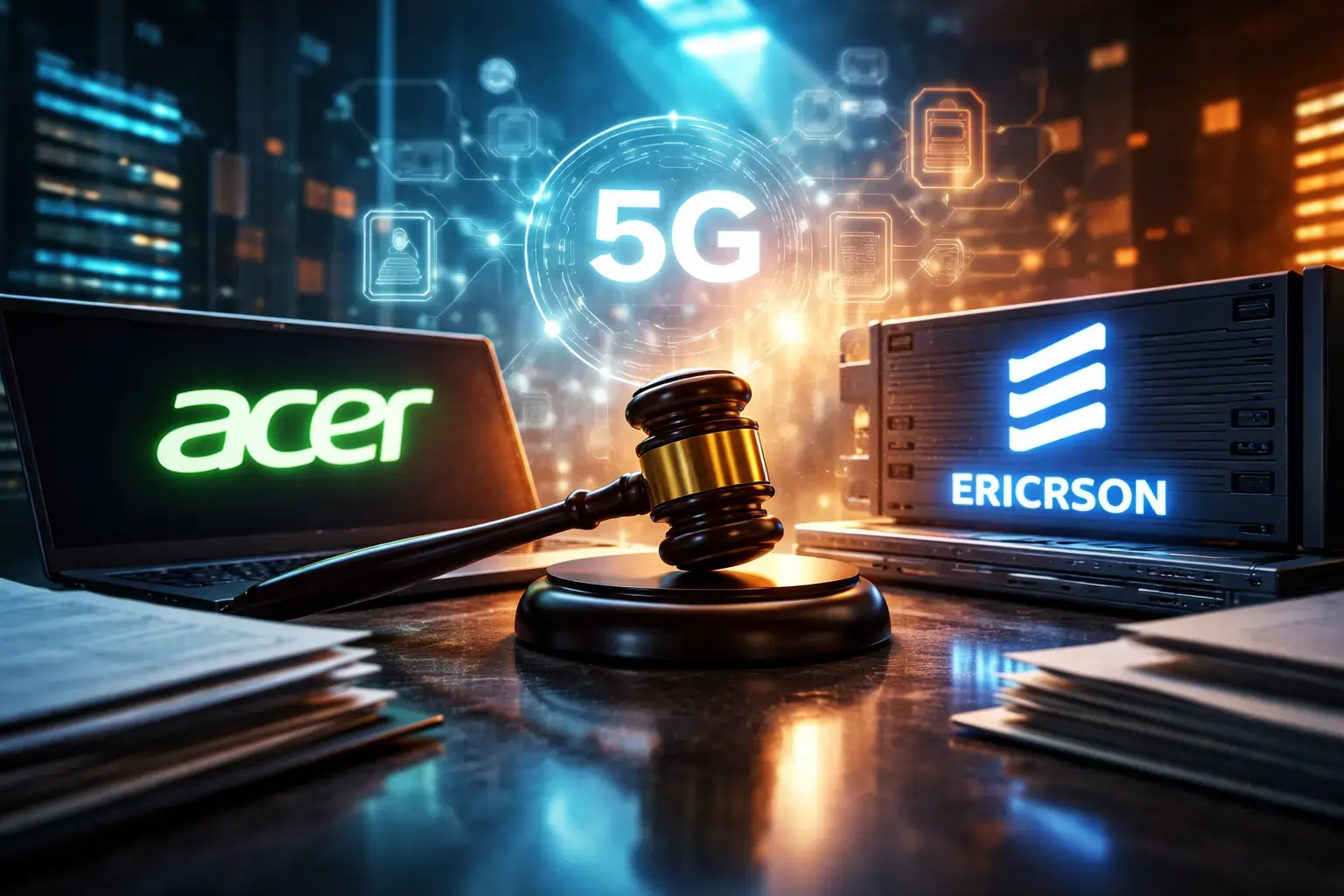
Acer Inc. has escalated its patent fight with Ericsson Inc., accusing the telecom equipment maker of forum shopping in a widening dispute over 4G and 5G technology licensing.
The conflict now spans multiple jurisdictions, including a case filed in Delaware federal court and parallel proceedings tied to Texas patent litigation. The outcome could influence how global device makers negotiate royalties for standard-essential patents tied to mobile connectivity.
Acer recently filed a motion to dismiss certain claims brought by Ericsson. The company also seeks a declaratory judgment action asserting noninfringement and challenging the scope of Ericsson’s asserted patents.
At the center of the telecom patent conflict are standard-essential patents covering 4G LTE and emerging 5G infrastructure. These patents are critical to devices that connect to mobile networks operated by carriers such as AT&T Inc., T-Mobile USA Inc., and Verizon Communications Inc..
Ericsson alleges that Acer devices rely on patented technology embedded in mobile carrier base stations and network interoperability standards. Acer disputes both infringement and the fairness of the licensing demands.
The forum shopping claim is central to Acer’s latest filings. The company argues that Ericsson is attempting to steer litigation into venues perceived as more favorable to patent holders, particularly in Texas, long known for high-stakes intellectual property litigation.
Venue strategy has become a decisive factor in US patent disputes. Courts in Texas, especially in the Eastern and Western districts, have historically attracted plaintiffs due to expedited schedules and experienced patent dockets. Delaware, by contrast, is often preferred by corporate defendants due to its concentration of incorporated entities and perceived procedural balance.
Acer’s motion to dismiss challenges jurisdictional and procedural aspects of Ericsson’s complaint. The company is seeking a noninfringement claim ruling that could limit exposure and clarify its licensing obligations under fair, reasonable, and non-discriminatory terms, commonly referred to as FRAND.
The 4G technology dispute and the related 5G patent lawsuit reflect broader tensions in the mobile ecosystem. As device margins compress, royalty rates for standard-essential patents are under sharper scrutiny. Laptop and PC manufacturers that integrate cellular connectivity face increasing pressure to negotiate cross-border patent licenses with telecom infrastructure vendors.
Industry analysts note that Ericsson relies heavily on intellectual property revenue. Licensing income remains a material contributor to its balance sheet, especially as global 5G rollouts mature and capital expenditures by carriers stabilize.
For Acer, the stakes are different. The company competes in a low-margin hardware market. Expanding into always-connected laptops and IoT-enabled products increases exposure to telecom patent claims. A court ruling on noninfringement or royalty boundaries could materially affect product cost structures.
The dispute also underscores evolving enforcement patterns. Telecom vendors are increasingly targeting end-device manufacturers rather than solely negotiating at the chipset level. This strategy shifts liability further down the supply chain and broadens the scope of potential defendants.
Regulatory context adds another layer. Global competition authorities have intensified scrutiny of how standard-essential patents are licensed. Courts in the US and Europe are recalibrating how FRAND obligations are interpreted, particularly in multi-jurisdictional disputes.
Investors are watching closely. Prolonged litigation increases legal costs and introduces uncertainty around future licensing frameworks. A decisive ruling in Delaware could reshape negotiating leverage not only between Acer and Ericsson but across the wider hardware and telecom sectors.
The immediate question is procedural. If the Delaware federal court narrows or dismisses key claims, it may weaken Ericsson’s parallel Texas patent litigation strategy. If not, Acer could face simultaneous proceedings with heightened financial exposure.
The longer-term implications extend beyond these two companies. As 5G deployment deepens and early 6G research accelerates, the boundaries of intellectual property litigation in wireless standards will grow more contested.
This case highlights a structural shift in the telecom patent conflict landscape. Connectivity is no longer confined to smartphones. It now spans laptops, industrial devices, and edge computing hardware. Each integration point introduces new legal complexity.
For further details on the litigation developments, see Bloomberg Law’s coverage of the dispute.
For now, the battle remains procedural. But the underlying issue is strategic control over the economics of next-generation wireless technology. The courts will determine venue. The industry will absorb the consequences.