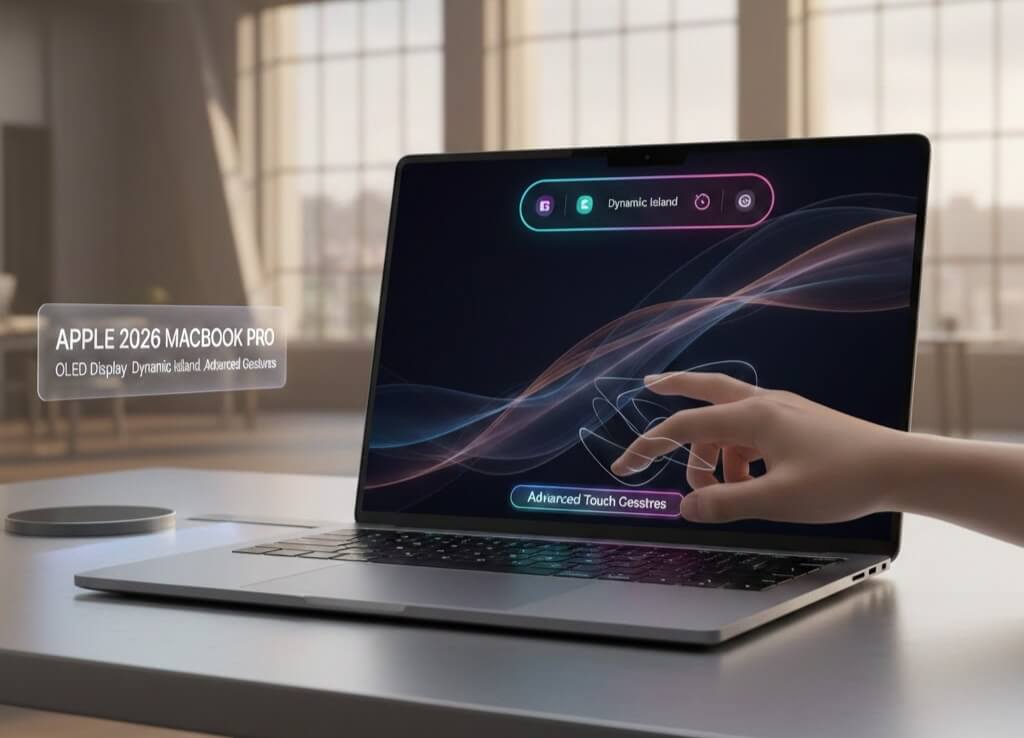
For years, the MacBook Pro has been the safe bet — powerful, polished, predictable. But Apple’s 2026 MacBook Pro Refresh: Dynamic Island, OLED Display Upgrade, and Advanced Touch Gestures Revealed signals something more ambitious. Apple isn’t just updating a laptop. It’s redrawing the boundary between macOS and the touch-first world it created on the iPhone and iPad.
If the leaks and supply-chain reporting hold, the 2026 MacBook Pro refresh could mark the most consequential redesign since Apple Silicon debuted. And if you rely on a MacBook Pro for work, creativity, or business, this shift isn’t cosmetic. It changes how you interact with your machine.
The headline feature — a MacBook Pro Dynamic Island — sounds almost playful at first. On the iPhone, Dynamic Island reframed the notch into a living interface. On a laptop, the stakes are different. Screen real estate is sacred.
Yet the rumored MacBook Pro notch replacement isn’t just about aesthetics. A Dynamic Island on Mac could evolve into a contextual command hub. Think live rendering progress, audio controls, AirDrop transfers, or real-time AI processing indicators hovering in a space you already glance at. Instead of passive hardware housing a camera, it becomes an active layer of information.
That matters because laptops are multitasking machines. We juggle Slack, Zoom, Final Cut, spreadsheets, and browser tabs. A Dynamic Island on Mac isn’t about flair; it’s about ambient awareness. If executed well, it reduces friction. If executed poorly, it becomes distraction. Apple’s design discipline will be tested.
The second major shift — the MacBook Pro OLED screen — may prove even more significant. For years, Apple relied on mini-LED technology in its high-end notebooks. It delivered brightness and contrast, but OLED is a different class of display.
An Apple OLED laptop promises deeper blacks, pixel-level lighting control, and improved color accuracy. For photographers, filmmakers, and designers, this isn’t incremental. It changes how you evaluate shadow detail and color grading. For everyone else, it means text that looks etched into glass and video that feels cinematic without external monitors.
The OLED vs mini-LED MacBook debate isn’t theoretical. OLED panels typically offer better contrast but can raise concerns about burn-in and longevity. Apple has likely spent years solving those issues before approving the shift. The company rarely moves display technology into the Pro line without confidence in durability.
There’s also power efficiency to consider. OLED can be more efficient when displaying darker interfaces — something macOS already leans into with dark mode. Pair that with the anticipated MacBook Pro M5 chip under the Apple Silicon 2026 roadmap, and we’re looking at potential gains in both battery life and sustained performance.
Performance improvements matter because Apple Silicon reshaped expectations. The transition from Intel to M-series chips gave users workstation-class speed with laptop thermals. The MacBook Pro M5 chip is expected to push further into AI acceleration, neural processing, and graphics performance.
Why should you care? Because creative workflows are becoming AI-assisted by default. From photo enhancement to code generation to video upscaling, AI tasks are local and constant. A next-generation MacBook Pro must handle that load without throttling or noise. Apple’s advantage lies in tight hardware-software integration. If the M5 is optimized for macOS gesture controls and real-time UI elements like Dynamic Island, the experience could feel seamless rather than layered on.
Then there’s the most controversial rumor: advanced Apple laptop touch gestures. Not a touchscreen in the traditional sense — at least not yet — but expanded gesture zones, possibly near the trackpad or keyboard deck, enabling new macOS gesture controls.
Apple has historically resisted touchscreens on Macs, arguing that vertical touch causes fatigue. But behavior is shifting. Users expect fluid, tactile control. Advanced touch gestures could offer a middle ground — preserving ergonomic integrity while allowing more direct manipulation of timelines, canvases, and UI layers.
If this sounds like echoes of the Touch Bar era, you’re not wrong. The Touch Bar promised context-aware controls but failed to win over many professionals. The difference this time may be integration. Instead of isolating controls to a thin strip, gestures could be embedded into broader system interactions, supported by Apple productivity features across macOS.
The broader MacBook Pro redesign 2026 appears less about novelty and more about convergence. Apple is aligning its platforms. iPhone users understand Dynamic Island. iPad users understand touch. Mac users understand performance. The 2026 MacBook Pro refresh blends those instincts into one device.
And that’s where timing becomes critical. The MacBook Pro release date 2026, if it aligns with Apple’s usual fall cycle, would land amid accelerating competition. Windows OEMs are embracing OLED displays, AI-first chips, and hybrid touch devices. Apple cannot afford to iterate cautiously forever.
There’s also the question of price. The MacBook Pro price 2026 is unlikely to fall. OLED panels are costly. Advanced silicon isn’t cheap. If Apple layers in significant hardware changes, consumers may face higher entry points.
So you’ll need to ask: does this upgrade meaningfully change your workflow? If you’re on an M1 or M2 MacBook Pro, the leap to M5 with OLED and new gesture systems could be transformative. If you’re on an M3 or M4 model, the improvements may feel evolutionary rather than essential.
What happens next depends on execution. Apple’s strength has always been restraint. It doesn’t usually adopt features just because competitors do. If Dynamic Island appears on the Mac, it will be because Apple believes it enhances utility, not because it photographs well in marketing slides.
Still, MacBook Pro rumors have a way of inflating expectations. Not every leak survives final design. Supply-chain whispers can mislead. But when multiple threads — OLED panels, redesigned display cutouts, next-generation Apple Silicon — converge, patterns emerge.
The deeper story behind Apple’s 2026 MacBook Pro Refresh: Dynamic Island, OLED Display Upgrade, and Advanced Touch Gestures Revealed isn’t about any single feature. It’s about identity. The MacBook Pro has long been the workhorse of creative professionals, developers, and executives. Apple now faces a choice: preserve that stability or reimagine it for an AI-centric, cross-device future.
If you depend on your laptop for income, attention to this cycle matters. Hardware investments last years. Buying just before a major redesign can mean missing foundational improvements. On the other hand, waiting indefinitely can stall productivity.
In the coming months, watch for confirmation of panel suppliers, developer hints inside macOS betas, and performance benchmarks tied to Apple Silicon 2026. Those signals will clarify whether this refresh is cosmetic evolution or structural reinvention.
For now, one thing is clear: Apple’s 2026 MacBook Pro Refresh: Dynamic Island, OLED Display Upgrade, and Advanced Touch Gestures Revealed is shaping up to be more than a spec bump. It represents Apple testing how far it can stretch the Mac without breaking what made it indispensable.
If Apple gets the balance right, the next-generation MacBook Pro won’t just look different. It will feel different in your hands — faster, smarter, more aware of what you’re doing and what you need next. And that, more than any single feature, is what could define the next era of the Mac.